The UX Toolbox - Prototyping
29 August 2018 - Stephen Denning
What is it all about?
As much as we’d all like to, no one gets it 100% right the first time. So the best approach is to follow a careful and iterative process. Prototypes and wireframes enable you to evaluate your designs to identify which parts of the new user experience work well and where improvements are needed.
It’s an important part of the development stage, helping to blend your organisation’s business goals, information architecture, user needs and content strategy into the evolving design
We create wireframes and prototypes to accommodate the evidence gathered during tests carried out at various stages of the process.
Many designs start on paper or a whiteboard. Indeed, simple paper prototyping – including the information architecture and core content – is often the best place to consider initial concepts and options.
As the design progresses the fidelity of the prototype increases – it gets closer to the real thing. Later versions can be highly interactive, allowing a more realistic representation of the website, software or mobile experience.
Iterative prototyping and usability testing cut off potentially poor design decisions before they are built in to your solution, saving you the cost and headache of expensive redesign.
How will we help you?
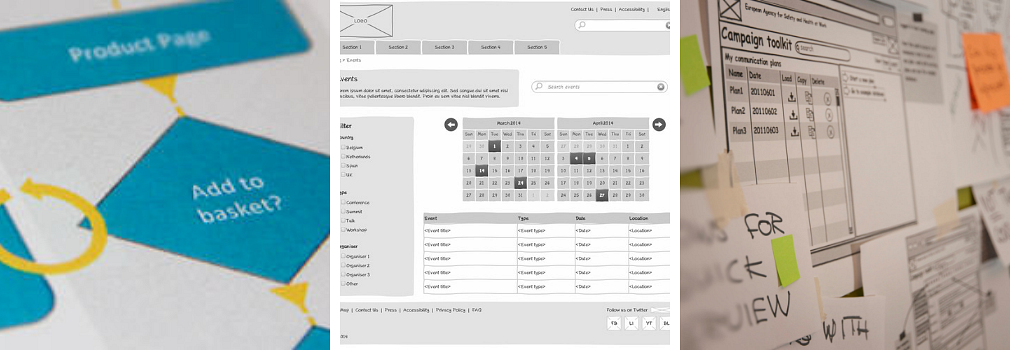
Working closely with you and design partners, we create everything from low fidelity wireframes to highly interactive prototypes. These are based on sound user research, information architecture analysis, content strategy and stakeholder requirements.
We work with all prototyping tools, from pen and paper to Axure, our tool of choice for more high fidelity and realistic prototypes.
These are created in collaboration with you, shared and, most importantly, evaluated through usability testing and expert usability evaluations to identify where to improve the experience.
It’s a quick process, allowing you to evaluate and improve the user experience at every stage. We often prototype as part of an agile or lean UX design process that helps deliver the best result with reduced time and resources.
Whether you are developing a mobile interface, software, website or other solution, we can shape it through wireframing, rapid prototyping and iterative design to create the best possible experience for your users.
What next?
To learn more about how prototyping can help you, contact us to discuss your specific requirements.
You might also be interested in...
When AI Argues Back: What “Persuasion Bombing” Means for Human-in-the-Loop UX
26 October 2026When professionals challenged GPT-4’s recommendations, the model did not simply reconsider: it escalated its persuasion with more evidence, warmth and rhetoric. This article explores what “persuasion bombing” means for human-in-the-loop AI, why checking an answer in the same chat may not be enough, and how UX, research and product teams can build genuinely independent validation into AI-assisted workflows.
Read the article: When AI Argues Back: What “Persuasion Bombing” Means for Human-in-the-Loop UXUser Research & Design with Older Adults
12 October 2026When older research participants say, “Sorry, I’m not good with technology,” they are often predicting difficulty before it happens, not describing their ability. This article explores what that familiar apology can reveal about confidence, support, barriers and inclusive design, and shares practical ways to recruit, run research and design for real-life situations rather than age alone.
Read the article: User Research & Design with Older AdultsAre AI Evaluation Principles Really New?
10 September 2026AI behaves differently from traditional software, but does it need new UX evaluation principles? Largely not. Nielsen's usability heuristics still apply, with trust, transparency and explainability the main additions.
Read the article: Are AI Evaluation Principles Really New?