Guessing the Top Tasks at the European Commission
7 December 2018 - Chris Rourke

Top Tasks Identification is a powerful quantitative method for learning the most important tasks for the customers of an organisation. It has been implemented on hundreds of projects and helps to align the content and functionality of a website with the users’ top tasks, leading to a better navigation design and overall user experience.
One of the largest projects to apply Top Tasks was for the European Commission where over 100,000 EU site visitors took part in a Task Identification exercise, selecting their top 5 tasks they would want to perform from a list of 77 possible tasks. The results, showed that 25% of the collective votes were assigned to just 6 of these tasks, as shown in this pie chart.
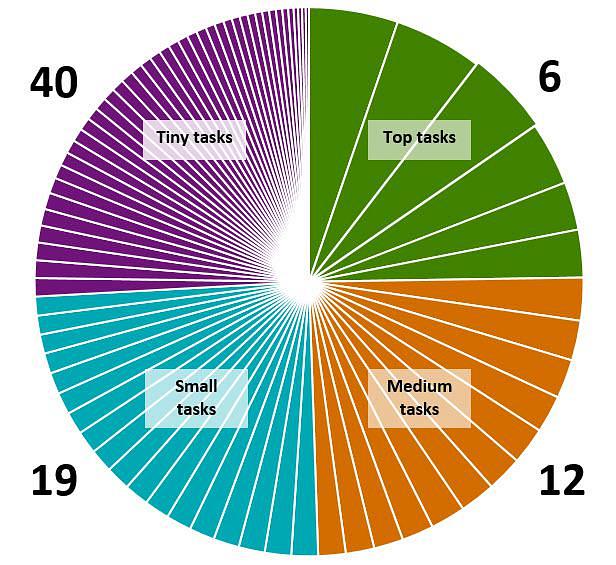
In this World Usability Day exercise we asked participants to guess these top tasks. And in the process they got an insight into how the task identification process works from the participant’s point of view.
Rather than the full 77 tasks, we provided a smaller list of only 30 tasks but within these were the real top 6 tasks. During World Usability Day 20 participants tried to guess the most popular tasks from the original research.
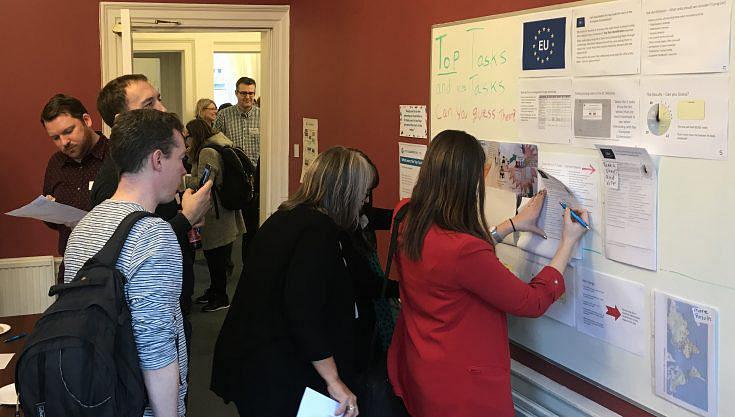
The results were interesting and not surprisingly there were several differences between the projected top tasks from the World Usability Day (WUD) participants and the rankings from the actual study. For a starter, the audience attending our event were not necessarily users of EU services or familiar with the institution’s digital channel.
However, our small sample of 20 people showed a few areas where the WUD participants concurred with the larger sample from the actual study. For instance, the # 3 task from the EU’s actual study sample was Funding, grants and subsidies, which received the 2nd most votes among our participants. However, the task that our WUD group assigned the most votes to (12 in total from 20 people) was Travel within, to and from EU (documents, visa, consular help, currencies) which was 33rd out of the 77 rank ordered tasks from the actual study.
And in case you were wondering what were the top 6 tasks chosen from the actual EU study with over 100,000 people – here they are:
- EU law, rules, treaties, judgements
- Research and innovation
- Funding, grants, subsidies
- Education and training in EU
- EU strategy, political priorities
- Environmental protection
The European Commission applied this information to help improve their content and information architecture to base it more around actual user tasks. This greatly improved the task success on the site and overall experience. More information about their study can be found on the official website of the European Commission(this will open in a new window).
At User Vision we regularly perform top task exercises such as task identification and task performance indicator to improve the online customer experience to bring about similar results for our clients.
You might also be interested in...
The Unintended Consequences of Making Things Easier
7 September 2026AI scribes save GPs time, but University of Edinburgh research suggests other things change too. Three lessons on behaviour, trust and effort for anyone introducing AI into a service people rely on.
Read the article: The Unintended Consequences of Making Things EasierWhy positionality matters in UX research
29 July 2026Positionality is the lens every UX researcher brings to their work. This article explores how who is asking the questions shapes what users share, how insights are interpreted, and why recognising our own perspective leads to better, more inclusive research.
Read the article: Why positionality matters in UX researchCreating Space for Surprise in User Research
1 June 2026Good user research creates space for surprise - exposing blind spots, challenging assumptions and helping teams make better decisions.
Read the article: Creating Space for Surprise in User Research