AI can design a screen, but it still can’t feel one!
16 January 2026 - Chris Rourke
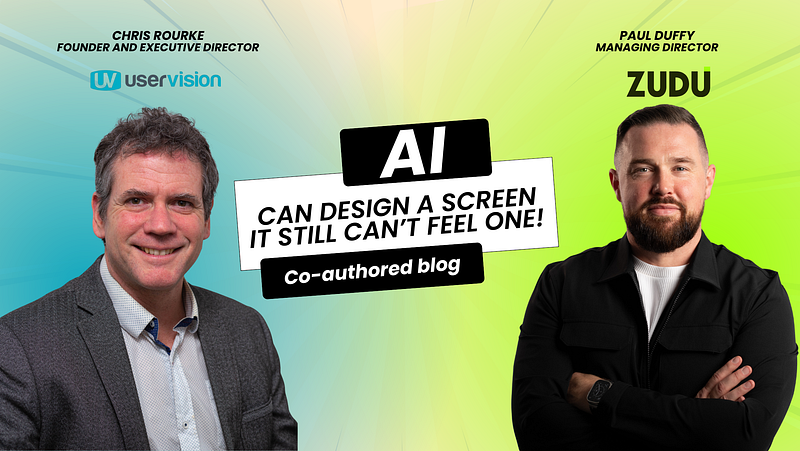
Written by Paul Duffy, Managing Director of Zudu
Firstly, it’s an absolute honour to co-author this piece with the absolute powerhouse that is Chris Rourke(this will open in a new window) – I have been incredibly impressed with Chris’s experience and approach to business, UX, UI and just his outlook on life, for a number of years now, being able to smash our thoughts together on paper like this is a privilege.
Everyone’s talking about how AI is changing design and reshaping user experience, some for the better, others not so much.
I’ll be honest. There was a time earlier in my career when I didn’t even know what UX or UI meant. It sounded like one of those design terms that cool design people threw around while I focused on commercials, delivery, or business strategy. Having built businesses over the last 15 years, I’ve made an absolute arse of design more than once. I completely overlooked how something felt whilst using, until the client complaints started rolling in. It doesn’t, or at least shouldn’t, take long to realise how critical user experience really is. Usually, it hits you the first time you wrestle with an app so poorly designed that you want to test its “smash-ability.”
What I am seeing in the market is a much sharper eye for this. I am speaking to many business owners who are prioritising guest experience and design, and it’s refreshing to see. Are we moving towards a world where poor guest experience and design are a thing of the past?
My involvement in design has always been light, but over the years, working across B2C, B2B and everything in between, I’ve learned that how something works matters as much as what it does. A great UX quietly removes friction, builds confidence, and earns trust without needing to explain itself. You know it’s right when you stop noticing it. You just flow. When you don’t, even the smartest product feels wrong. That’s when you realise design is direction and not just decoration.
Design has shifted from being a phase at the end to being the foundation of everything. It’s not about colours or layouts. It’s about clarity. How fast can a user achieve what they came for? How do they feel while doing it? That emotional layer is where products win or lose, and that’s human!
AI can generate layouts, test some aspects of accessibility, and predict user flows in seconds. It can suggest the “optimal” journey, palette, or interaction. Impressive, yes. But understanding why a human hesitates before clicking, or why a page that looks perfect still doesn’t feel right, is something else entirely. That’s human. That’s instinct. That’s empathy.
AI has made design faster, but not more felt. It can map journeys but not emotions. It can replicate patterns but not curiosity. And in a world that values speed above everything, that’s the part worth protecting.
I’ve seen small UX details decide whether a product converted or collapsed. Rarely because the technology failed, but because the experience didn’t feel right. When you’ve watched someone struggle with a journey you thought was flawless, you realise no dataset could have predicted that pause. That hesitation says everything. It’s the kind of feedback AI can’t interpret, but humans understand instinctively.
The irony of AI is that it’s teaching us to be more human. The more we automate, the clearer it becomes that empathy, curiosity, and trust will always be what make a product truly work.
At Zudu, we utilise AI to provide our teams with more space to think, test, and question. The more noise AI removes, the more room there is for human creativity and craft. At the forefront of incredible design and, more specifically, user experience is User Vision. There is no way I could solo-pilot this blog without adding the powerhouse of credibility that is Chris Rourke, Founder of User vision, the user experience gurus and the insight-led, human-centred design agency, with whom I’ve been highly impressed for years now. The synergy between Zudu’s Relentlessly Human approach and User Visions’ human-centred approach is strong.
Written by Chris Rourke, Founder and Executive Director of User Vision
It’s always a pleasure talking with Paul Duffy(this will open in a new window) and catching up on his latest news. Paul brings a rare blend of technical knowledge, creativity and leadership skills to every conversation, and he and the Zudu team turn complex ideas into powerful solutions.
I come to this conversation from a very different angle. I’m not a technologist by trade, I’ve never written code for a living, and I have no intention of starting now. My background has always been rooted in understanding how humans interact with their environment with physical spaces or digital interfaces. With AI, we view this challenge through a new lens where trust and intuitive design are paramount.
What’s always intrigued me is that invisible layer between intention and action. Why do they trust one website immediately and doubt another that looks similar? Why does a feature that tests perfectly in lab conditions completely fail when personal and contextual factors come into play?
The answers are rarely technical. They’re human. As a user experience consultant, I see firsthand the issues users face when working with technology that hasn’t been designed for their needs. I watch people struggle—not because they’re incapable, but because the system assumes they think like the people who built it.
Many of our projects involve discovery research—understanding user needs before a single pixel is designed. This is just as important as evaluative research like usability testing. Because by the time you’re testing a prototype, you’ve already made dozens of decisions based on assumptions. If those assumptions are wrong, you’re rebuilding, which radically increases project costs.
The most critical insights are often the most subtle. It’s the tiny moment of uncertainty. The hesitation before a button click. The confusion over a label that made perfect sense in the design meeting but means little outside that room. Then there are expectations no one knew existed. These ‘errors of omission‘ stem from insufficient understanding of user needs, causing users to lose confidence and pause mid-task.
These details are invisible to AI or based on overly generalised information lacking individual context. They’re barely visible to us unless we go looking. And that’s exactly what we do.
We sit with users to understand their ‘job to be done’ and identify what will make or break their experience. We watch them navigate from discovery to completion. We listen to what they say and notice when body language shifts, when confidence drops, when they second-guess themselves. We ask why—not confrontationally, but to understand their mental model, their drivers, their motivation. We surface circumstances that could impact their ability to complete tasks, from individual impairments to real-world contexts.
People don’t fail because they’re not smart enough. They fail because the product doesn’t align with how they naturally think and behave.
Take trust. It isn’t a feature you can add. It emerges from countless micro-decisions—clarity of information, consistency of behaviour, respect for the user’s time. If anyone is off, trust erodes and is hard to recover. Or consider perceived benefit. If users can’t immediately grasp what’s in it for them, or if the path feels too effortful, they’ll walk away. The old adage “If the user can’t use it, it doesn’t work” lives on in the age of AI.
This is why we spend time in the upfront discovery phase—capturing needs, motivations, and expectations before decisions get locked in.
There’s a synergy between what Paul’s team does at Zudu and what we do at User Vision. AI gives you speed, scale, and automation of repetitive tasks. But it can’t tell you why someone hesitates. It can’t feel the difference between “this works” and “this feels right.”
That’s where humans come in. That’s where empathy, curiosity, and deep understanding create experiences that don’t just function, they resonate.
AI is a powerful tool, but its value depends entirely on the human wielding it. If we use it to move faster without understanding better, we’ll just make mistakes more efficiently. But if we use it to create space, space to think, to listen, to truly understand the people we’re designing for, then we can build something genuinely better.
Not just smarter and faster, but more human.
And in a world increasingly shaped by artificial intelligence, that might be the most valuable thing we can offer.
You might also be interested in...
The shopping cart battleground: what Amazon's shopping agent standoff means for UX
21 September 2026Amazon has now blocked AI shopping agents from Perplexity, Google, OpenAI and Meta. Behind the legal arguments sits a UX problem: customers who ask an agent to buy for them and hit a wall. Here is what the standoff means for your customer journeys, and three questions to ask now.
Read the article: The shopping cart battleground: what Amazon's shopping agent standoff means for UXBuilding Accessibility with Generative AI: Five Things Teams need to Consider
18 September 2026Generative AI is changing how quickly teams design and build, but speed does not guarantee accessibility. Here are five things to consider, from putting accessibility into the prompt to testing the experience and knowing who stays responsible.
Read the article: Building Accessibility with Generative AI: Five Things Teams need to ConsiderAre AI Evaluation Principles Really New?
10 September 2026AI behaves differently from traditional software, but does it need new UX evaluation principles? Largely not. Nielsen's usability heuristics still apply, with trust, transparency and explainability the main additions.
Read the article: Are AI Evaluation Principles Really New?