Accessibility Toolkit - Empathy Workshops
1 January 2025 - Chris Rourke
Organisations seeking to build a deep and effective understanding of accessibility in their teams need to go beyond theoretical knowledge. They must grasp what it's truly like to live with a disability and how it impacts engagement with digital services. The best way to spread knowledge about inclusive design is to demonstrate the challenges faced by people with disabilities and the effective solutions that they can implement.
Our empathy workshops provide hands-on experiences that allow participants to truly grasp the challenges faced by individuals with disabilities. These workshops are designed to foster empathy and inspire a commitment to creating accessible products and services.
What to Expect from Our Empathy Workshops
Our empathy workshops offer a unique and interactive approach to learning about accessibility. Participants will engage in a variety of activities that simulate different impairments and explore the use of assistive technologies. Here’s what you can expect:
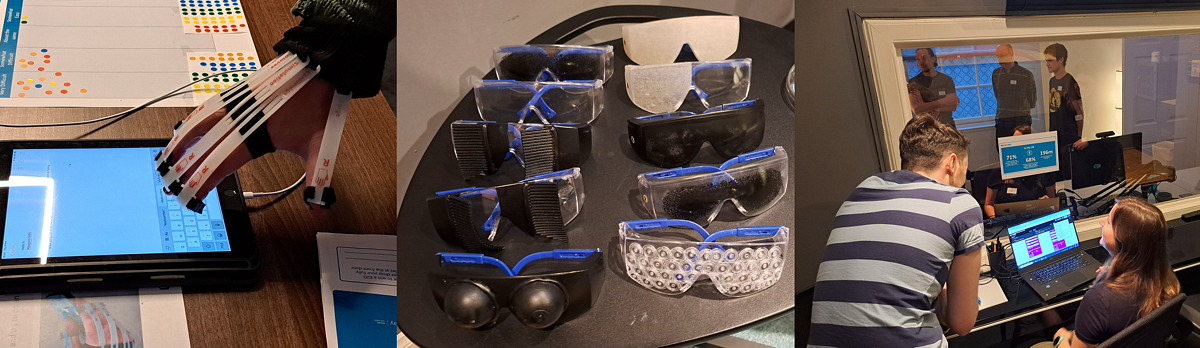
- Interactive stations: Participants rotate through interactive stations that simulate various impairments. This includes wearing glasses to experience visual impairments, using simulation gloves to understand limited dexterity, and more.
- Assistive technology demonstrations: Explore how screen readers and other assistive technologies work on both desktop and mobile devices. Gain insights into how these tools assist users in navigating digital content.
- Hands-on experiences: By simulating the challenges faced by individuals with disabilities, participants gain a deeper understanding of the importance of inclusive design. These hands-on experiences are designed to be eye-opening and impactful.
- Expert discussions: Our workshops provide a valuable opportunity to discuss accessibility with our expert consultants. Learn from their experiences, ask questions, and gain practical advice on how to prioritise accessibility in your work.
Why Choose User Vision for Empathy Workshops?
- Experienced facilitators: Our workshops are led by experienced consultants who are passionate about accessibility and skilled in creating engaging, educational experiences.
- Customised to your needs: We tailor our workshops to address the specific challenges of your organisation and products, which ensures that the content is relevant and impactful.
- Interactive and engaging: Our hands-on approach ensures that participants are fully engaged and leave with a deeper understanding of accessibility issues.
- Fostering a culture of accessibility: By participating in our empathy workshops, your team will be better equipped to create inclusive products and services that meet the needs of all users.
Ready to get started?
Empower your team with a deeper understanding of accessibility through our empathy workshops. Contact us to learn more about how these workshops can benefit your organisation. At User Vision, we are dedicated to helping you create a more inclusive digital world by fostering empathy and prioritising accessibility.
You might also be interested in...
Building Accessibility with Generative AI: Five Things Teams need to Consider
18 September 2026Generative AI is changing how quickly teams design and build, but speed does not guarantee accessibility. Here are five things to consider, from putting accessibility into the prompt to testing the experience and knowing who stays responsible.
Read the article: Building Accessibility with Generative AI: Five Things Teams need to ConsiderThe Unintended Consequences of Making Things Easier
7 September 2026AI scribes save GPs time, but University of Edinburgh research suggests other things change too. Three lessons on behaviour, trust and effort for anyone introducing AI into a service people rely on.
Read the article: The Unintended Consequences of Making Things EasierThe Deadlines Moved. The Standard Didn't.
24 August 2026Two accessibility deadlines moved in opposite directions this year. The EAA turned one in June and enforcement is now visibly ramping up across EU member states, while the US extended its ADA Title II deadline for state and local governments to April 2027 or 2028, depending on size. Neither is a reason to relax: both frameworks converge on WCAG 2.1 AA as the baseline, and this piece sets out what the extra runway is actually for.
Read the article: The Deadlines Moved. The Standard Didn't.