Nothing About Us Without Us: What CRPD at 20 Means for UX
16 June 2026 - Raimonda Sidaraite
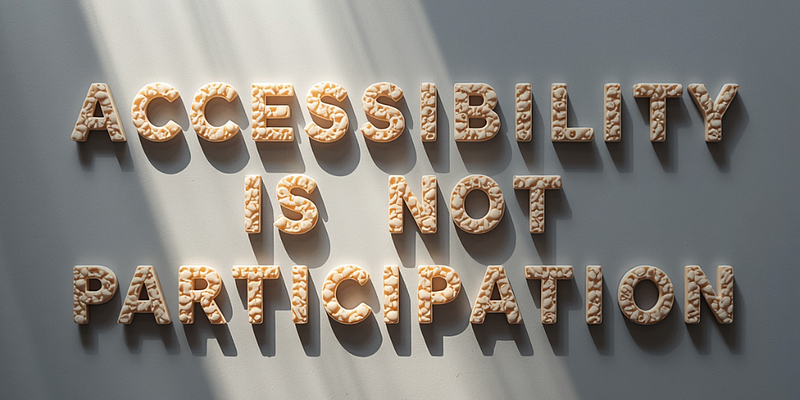
As the Convention on the Rights of Persons with Disabilities (CRPD) turns 20, the question is no longer whether disabled people should be included. The more important question is whether they have any real influence over the decisions that shape their lives.
Right now, representatives from across the world are gathering at the United Nations in New York for the 19th Conference of States Parties to the Convention on the Rights of Persons with Disabilities (COSP19). The theme is CRPD at 20: Celebrating and consolidating achievements and shaping the next phase of implementation in a changing world. Twenty years on from the Convention’s adoption in 2006, it is worth asking what this means beyond policy and into the design of products and services people use every day.
It would be easy to treat this as something for governments, campaigners or legal teams. That would be a mistake. For anyone working in UX, service design or accessibility, the CRPD raises questions that go to the heart of how decisions get made, whose needs shape those decisions, and what inclusion really looks like in practice.
The Social Model of Disability Should Already Feel Familiar to UX
At its core, the Convention on the Rights of Persons with Disabilities reframes disability. It does not treat disability as a problem in the person that needs to be managed or accommodated. It understands disability as something created by environments, systems and decisions that exclude people. In other words, the problem sits in the design of the world around us.
For anyone working in UX, that should sound familiar. We already recognise, at least in principle, that when someone struggles to use a product or service, the answer is not to blame the user. The answer is to examine the design. Accessibility and inclusive design are grounded in that same principle. The user is not the failure. The design is.
The Convention also changed how disabled people are positioned. They are not passive recipients of support. They are participants in decisions that affect their lives. That shift matters for design too. It raises a harder question than whether something is technically accessible: who had a say in shaping it in the first place?
What CRPD at 20 Means for Accessibility and Inclusive Design
COSP19 has three main sub-themes. Read through a UX lens, each one points to a question that product and service teams should already be asking.
1. Protection from exploitation, violence and abuse
In UX terms, this is partly a question about whether we design experiences people can genuinely navigate on their own terms, or whether we create journeys that work against them.
Dark patterns are one obvious example. When interfaces are designed to pressure, mislead or extract consent that people did not meaningfully intend to give, that is not neutral design. It is exploitation dressed up as interface design. And it does not affect everyone equally. People with cognitive disabilities, older adults, and anyone dealing with time pressure or complex interactions are more exposed to harm when digital experiences are confusing by design.
2. Empowerment, autonomy and independence
These are values UX teams talk about all the time. But saying we value autonomy is not the same as designing for it.
For many disabled people, independence is not about doing everything without help. It is about being able to do things on their own terms, at their own pace, and with the tools they rely on. When a product breaks assistive technology, forces rigid interaction patterns, or times out before someone has finished, it does more than create a frustrating experience. It takes control away. Accessibility failures can shift autonomy from the user to someone else, or remove it altogether.
3. Participation, representation and civic engagement
This is where the phrase “Nothing About Us Without Us” matters most.
One of the central questions at this year’s conference is how disabled people can be more meaningfully involved in the decisions that shape their lives. That principle sits at the heart of the CRPD. Disabled people were not only the subject of the Convention; they were involved in writing it.
The UX equivalent is straightforward to ask, but less comfortable to answer: are disabled people helping shape what we build, or are they only invited in once most of the important decisions have already been made?
In many organisations, disabled people only appear in the process through accessibility testing or an audit late in delivery. That work matters, but it is not the same as participation. There is a significant difference between asking whether something works for disabled people and involving disabled people in deciding what should be built, how it should work, and what good looks like in the first place.
Accessibility tells us whether something works. Participation decides what gets built.
Accessibility Is Not the Same as Participation
This is one of the most important distinctions in the article, and I think it is worth stating plainly.
Accessibility audits, reviews and testing are necessary. They help identify barriers, reduce risk, and improve outcomes. But on their own, they do not satisfy the wider principle behind “Nothing About Us Without Us”. They tell us whether designs work after decisions have been made. They do not guarantee disabled people had any influence over those decisions. This is where inclusive design needs to be more ambitious. It should not stop at evaluation. It should shape discovery, prioritisation and decision-making earlier in the process.
What This Means for UX Teams in Practice
If this principle is going to mean anything in product and service design, it should change how teams work.
That means:
- involving disabled people earlier in research and concept development, not only at the point of testing
- treating accessibility as part of defining the problem, not just checking the solution
- questioning who is missing when product decisions are being made
- recognising that compliance is a baseline, not the same thing as influence or participation
This is not simply a moral or legal issue. It is also a design quality issue. When disabled people are only brought in late, teams miss insight, narrow their thinking, and end up solving the wrong problems too often.
When disabled people are only involved at the end, we’ve already made most of the important decisions without them.
Twenty Years On: A Design Brief, Not Just a Policy Milestone
Twenty years on from the CRPD, there are real achievements to recognise and much more still to do. The gap between formal commitments and lived experience remains. In a world shaped by AI, political instability, and ongoing pressure to deprioritise accessibility, that gap could widen rather than close.
The Convention rests on a simple idea: that people are disabled not simply by impairment, but by the environments and systems around them, and that those with the power to change those environments have a responsibility to do so. For people working in UX, accessibility and service design, that responsibility appears in every brief, every recruitment screener, every workshop, and every definition of done.
Seen that way, the CRPD is not just a policy framework. It is also a design brief for a more inclusive world.
You might also be interested in...
The shopping cart battleground: what Amazon's shopping agent standoff means for UX
21 September 2026Amazon has now blocked AI shopping agents from Perplexity, Google, OpenAI and Meta. Behind the legal arguments sits a UX problem: customers who ask an agent to buy for them and hit a wall. Here is what the standoff means for your customer journeys, and three questions to ask now.
Read the article: The shopping cart battleground: what Amazon's shopping agent standoff means for UXBuilding Accessibility with Generative AI: Five Things Teams need to Consider
18 September 2026Generative AI is changing how quickly teams design and build, but speed does not guarantee accessibility. Here are five things to consider, from putting accessibility into the prompt to testing the experience and knowing who stays responsible.
Read the article: Building Accessibility with Generative AI: Five Things Teams need to ConsiderAre AI Evaluation Principles Really New?
10 September 2026AI behaves differently from traditional software, but does it need new UX evaluation principles? Largely not. Nielsen's usability heuristics still apply, with trust, transparency and explainability the main additions.
Read the article: Are AI Evaluation Principles Really New?