Kano as a Lens for Innovation and Competition
4 June 2026 - Kirsty Simpson

In Part 1 of this Kano article series, we explored how different types of product features influence customer satisfaction, and how the Kano model helps teams decide what to prioritise.
But Kano is not just a tool for shaping product roadmaps. It also offers a useful way to understand how companies compete over time.
When you step back, the same categories - Mandatory Features, Satisfiers and Delighters - do not just describe the makeup of products. They also help explain how organisations defend their position, differentiate, and respond to disruption.
In this article, we take that broader view, using Kano as a lens to explore how innovation plays out in the market.
Startups attack and disrupt
Startups rarely win by competing head-on with established companies on the same features. Incumbents usually have the scale, resources and experience to outperform new entrants on familiar ground.
Instead, startups typically win by introducing something genuinely different. Through a Kano lens, many of these innovations could be understood as Radical Delighters: ideas that fundamentally change how people engage with products and services, reshaping expectations and addressing needs in ways established players often overlook.
Inspired by Clayton Christensen’s work on disruptive innovation in The Innovator’s Dilemma, these ideas often emerge in secondary or niche markets that established firms may overlook because they seem too risky, too uncertain, or too disconnected from current customer expectations.
- they need differentiation to survive.
- they have less operational complexity.
- and they are under less pressure to protect existing revenue streams or serve a large installed customer base.
If one of these innovations gains traction, it can move from a niche market into the mainstream. What begins as a Radical Delighter can become a Mandatory Feature.
This is the moment often described as crossing the chasm: when an innovation moves beyond early adopters and begins to achieve mainstream acceptance. Crucially, many innovations never make that leap. The gap between early adopters and the early majority matters because early adopters are willing to experiment, while the early majority wants something proven, practical and low risk.
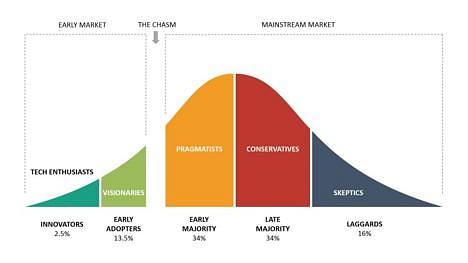
Many features that are now treated as standard began life as Radical Delighters. Electric windows, remote key fob locking, and air conditioning were once premium extras in cars. Today, they are widely expected. That is the core dynamic of disruptive innovation: what starts as surprising or niche can end up redefining the whole market.
Most established companies defend and sustain
Established companies face a different challenge. Rather than attacking markets through Radical Delighters, they usually focus their innovation efforts on defending against emerging disruptions while sustaining and refining the experiences customers already expect.
Defending
One of the biggest threats to established firms comes from Radical Delighters emerging in niche or secondary markets. These features may look small or irrelevant at first, but if they gain traction and move upmarket, they can quickly shift customer expectations and become the next Mandatory Features.
That is why established firms need to monitor these markets closely. What looks niche today can become tomorrow’s baseline expectation. By the time that shift is obvious, it may already be too late to respond.
That said, organisations should not adopt every emerging feature blindly. The strongest innovations are intentional, grounded in real user needs, not driven by novelty or competitive pressure alone.
“Start with user needs. Then search for the right solution.” IDEO
Sustaining
Alongside defending, established companies also focus on sustaining innovation: improving the performance areas customers already care about. In practice, that means refining the features they already do well, making them faster, more reliable and more convenient.
Rather than radically redefining markets, established companies are usually focused on keeping customers happy and improving the experience over time.
This kind of sustaining innovation often follows an S-curve: progress starts slowly, then accelerates, before eventually flattening as performance gains become harder to achieve.
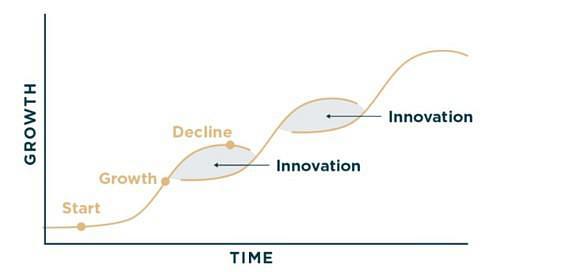
When companies reach that plateau, they often introduce emerging Mandatory Features, and sometimes smaller Delighters, to extend the life of existing Satisfiers and stay competitive while the category matures.
A few large companies do both
Most startups disrupt through experimentation and differentiation, while most established firms defend and sustain their position. But a small number of large organisations attempt to do both at once.
To pursue future disruption without undermining the core business, they often create semi-autonomous innovation units with their own leadership, goals, and sometimes their own commercial model. In effect, these groups behave more like startups within a larger organisation.
For example:
- Amazon created AWS (Amazon Web Services), which began as an internal capability but evolved into a semi-independent business with its own leadership, mission and profit model.
- Google operates X (formerly Google X or “The Moonshot Factory”), an innovation lab dedicated to long-term experimental technologies and radical innovation.
- Meta operates Reality Labs, a division focused on AR/VR and metaverse technologies, separate from Meta’s core social media operations.
All these examples were attempts to explore the kinds of Radical Delighters that could define future markets, while the core business continued improving existing Satisfiers.
The marketplace dynamic
Over time, this creates a repeating cycle:
- Startups introduce Radical Delighters in overlooked or emerging markets.
- Customers begin to adopt these ideas.
- Some of them become mainstream expectations and turn into Mandatory Features.
- Established companies absorb those expectations and continue improving Satisfiers.
- Performance gains plateau.
- New Radical Delighters emerge, and the cycle begins again.
Although successful products are usually built from a mix of Mandatory Features, Satisfiers and Delighters, startups often lean more heavily on Radical Delighters to attack and disrupt, while established companies rely more on Satisfiers to defend and sustain their position. Some large organisations are able to balance both approaches for maximum effect.
Deciding what to build next
Understanding how organisations use Kano categories to compete is one thing. The harder question is: what should you actually build next?
How do you work out which ideas are likely to delight customers, which are already expected, and which are unlikely to add meaningful value?
At User Vision, we often use Kano analysis to help organisations review existing features or evaluate new feature ideas before significant investment is made. Our approach goes beyond simple categorisation: we also assess the strength of customer support behind each result, helping teams understand not just what kind of feature something is, but how strongly people feel about it.
Whether you are shaping a roadmap, exploring new ideas, or looking for ways to stand out in a competitive market, Kano analysis can help you understand how customers are likely to perceive innovation before you commit time and money to building it.
Bringing strategy into focus
The value of Kano is that it links product thinking to market thinking. It helps teams understand not only what customers want, but how those wants change as the market matures.
For startups, that means identifying where to create meaningful difference. For established companies, it means knowing what to defend and what to improve. For larger organisations, it means balancing current performance with future opportunity.
That is why Kano remains relevant. It is simple enough to use in workshops, but strategic enough to inform decisions about competition, innovation and growth.
Next step
If you are deciding what to build next, or trying to understand how your product can stand out in a crowded market, Kano analysis can help you make a more informed choice.
If you would like support using Kano to shape your roadmap, test feature ideas or strengthen your innovation strategy, get in touch with User Vision.
You might also be interested in...
The shopping cart battleground: what Amazon's shopping agent standoff means for UX
21 September 2026Amazon has now blocked AI shopping agents from Perplexity, Google, OpenAI and Meta. Behind the legal arguments sits a UX problem: customers who ask an agent to buy for them and hit a wall. Here is what the standoff means for your customer journeys, and three questions to ask now.
Read the article: The shopping cart battleground: what Amazon's shopping agent standoff means for UXAre AI Evaluation Principles Really New?
10 September 2026AI behaves differently from traditional software, but does it need new UX evaluation principles? Largely not. Nielsen's usability heuristics still apply, with trust, transparency and explainability the main additions.
Read the article: Are AI Evaluation Principles Really New?The Unintended Consequences of Making Things Easier
7 September 2026AI scribes save GPs time, but University of Edinburgh research suggests other things change too. Three lessons on behaviour, trust and effort for anyone introducing AI into a service people rely on.
Read the article: The Unintended Consequences of Making Things Easier